Documenso is the open source alternative to DocuSign. We pointed our CLI at its repository and ran one command: holostaff /scan.
The scan reads the codebase the way a new engineer would. It does not run the app, it does not need analytics, and it does not need anyone to write content first. The skeleton of the map was live in about 90 seconds. The full map took a few minutes.
Nothing below is edited. You can explore the whole thing yourself, logged out, at holostaff.ai/demo.
What one scan found
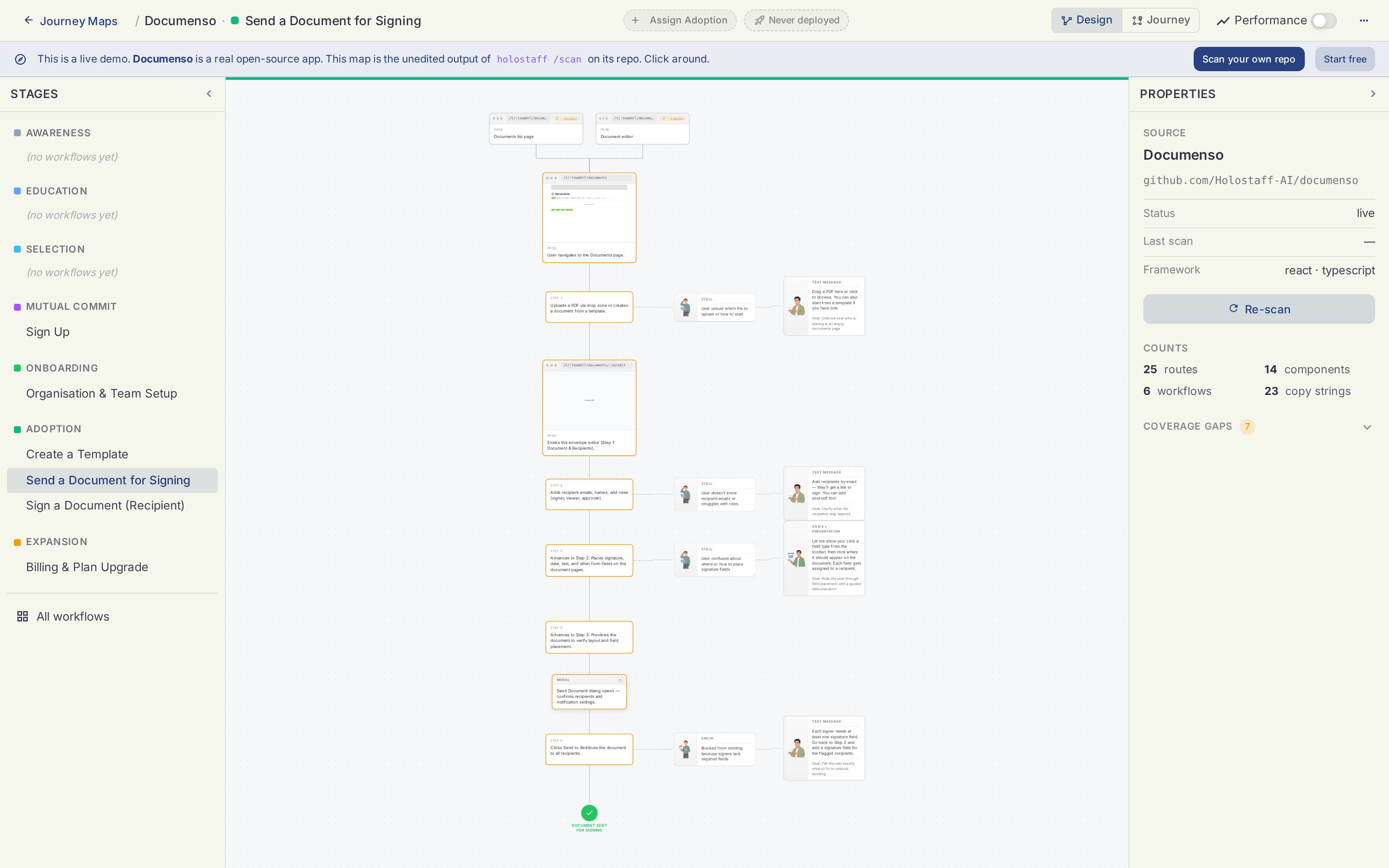
25 routes. 14 components. 23 customer-facing copy strings. 7 coverage gaps. And six workflows, placed on the customer journey: Sign Up, Organisation and Team Setup, Create a Template, Send a Document for Signing, Sign a Document as a recipient, and Billing and Plan Upgrade.
That last part matters. The scan does not just list screens. It arranges them into the journeys a real user walks, stage by stage, from first visit to paid plan.
Three risks the scan flagged
1. The empty dashboard.
Right after signup, a new user lands on a dashboard with nothing in it and no obvious next step. The scan flagged it from the code: the happy path assumes an organisation exists, and a fresh account has none. The copilot it designed for that moment says: "Welcome! Create your first organisation to start sending documents for signature."
2. Field placement.
Sending a document means placing signature fields on a PDF. The editor is powerful and quiet, and the scan marked this as the workflow's biggest stall risk. The intervention it proposed is a voice walkthrough: "Let me show you: click a field type from the toolbar, then click where it should appear on the document. Each field gets assigned to a recipient."
3. The silent blocker.
You cannot send a document if a signer has no signature field, and the send button tells you less than you would hope. The scan anchored an intervention to the exact error state: "Each signer needs at least one signature field. Go back to Step 2 and add a signature field for the flagged recipients."
Our favorite finding: silence
When a recipient opens a document to sign it, the scan chose no intervention at all. Its reasoning, verbatim: "Recipient just arrived; interrupting immediately would feel invasive. Allow 15s orientation."
Help that knows when to stay quiet is the whole point. A tour would have started talking.
Honest limits
The scan reads code, not production traffic. Its risks are hypotheses a founder would recognize, not measurements. It sees the copy users see, but only what lives in the repository. And very large monorepos take longer than this one did. The map is a starting staff briefing, not a crystal ball. Rehearsal against simulated users is where the hypotheses get tested.
Every product has this map hiding in its repo.
Yours included.
Explore the live map · or run npm install -g @holostaff/cli on your own repo.